[RecSys][과제4] 변분추론 기반의 생성모델 학습구현
[RecSys][과제4] 변분추론 기반의 생성모델 학습구현
과제4_변분추론 기반의 생성모델 학습구현
- 변분추론 기반의 VAE를 구현
- 유저사이드로 학습하고 클러스터링 결과를 확인
- 잠재벡터와 클러스터링을 연관짓고 모델의 학습경향을 시각화
데이터셋
과제 2와 마찬가지로 MovieLens Dataset을 사용한다.
출처 :Harper, F. M., & Konstan, J. A. (2015). The MovieLens Datasets: History and Context.
ACM Transactions on Interactive Intelligent Systems (TIIS), 5(4), 1-19. http://dx.doi.org/10.1145/2827872
과제 2와 마찬가지로 평점 데이터는 ratings_df 로 불러오고, 영화 정보 데이터는 movies_df 로 불러온다.
모델
과제3에서 정의했던 VAE모델을 그대로 사용한다.
유저벡터 활용 클러스터링
유저 잠재 벡터(z) 추출
VAE 모델을 사용해서 유저 잠재 벡터(z)를 추출한다. 잠재벡터는 유저-아이템 행렬을 모델에 입력하여 인코딩 레이어에서 생성된다. → 유저의 잠재적 특징을 나타내는 벡터를 얻을 수 있다.→ 유사한 선호도를 가진 유저들이 같은 클러스터에 속하고, 클러스터 별로 명확하게 구분하고 시각화 할 수 있다.
# 추론
with torch.no_grad():
     # FILL HERE # HOMEWORK(1)의 모델 출력 중 임베딩 생성에 필요한 변수만 사용
   hidden, _, _, _ =  vae(torch.Tensor(df_train.values))
vae 모델에서 hidden_vector z만 받아온다.
유저 클러스터링
- 추출된 유저 잠재벡터(z)를 이용해서 클러스터링을 수행하고 2차원으로 시각화 한다.
- K-Means를 클러스터링 기법으로 사용해서 유사한 특징을 가진 유저들을 그룹화 한다.
# 클러스터링
kmeans = KMeans(n_clusters=3, random_state=42)
clusters = kmeans.fit_predict(hidden)#kmeans.fit_predict(VAE의 latent vector)

# train 데이터의 user_item_matrix에 클러스터 추가
train_user_item_matrix = user_item_matrix.loc[df_train.index].copy()
train_user_item_matrix['cluster'] = clusters

# 결과 출력
print(train_user_item_matrix.head())
movieId    1    2    3    4    5    6    7    8    9   10  ...  1674  1675  \
userId                                                     ...
245      0.0  0.0  0.0  0.0  0.0  0.0  0.0  0.0  0.0  0.0  ...   0.0   0.0
83       4.0  4.0  0.0  2.0  0.0  0.0  0.0  0.0  0.0  0.0  ...   0.0   0.0
317      0.0  0.0  0.0  0.0  0.0  0.0  0.0  0.0  0.0  0.0  ...   0.0   0.0
351      0.0  0.0  0.0  0.0  0.0  0.0  0.0  0.0  0.0  0.0  ...   0.0   0.0
466      0.0  1.0  0.0  3.0  0.0  0.0  4.0  0.0  0.0  0.0  ...   0.0   0.0

movieId  1676  1677  1678  1679  1680  1681  1682  cluster
userId
245       0.0   0.0   0.0   0.0   0.0   0.0   0.0        1
83        0.0   0.0   0.0   0.0   0.0   0.0   0.0        1
317       0.0   0.0   0.0   0.0   0.0   0.0   0.0        0
351       0.0   0.0   0.0   0.0   0.0   0.0   0.0        1
466       0.0   0.0   0.0   0.0   0.0   0.0   0.0        1

[5 rows x 1683 columns]
유저가 속한 클러스터(0,1,2)를 2차원 matrix로 시각화 할 수 있다.
train_user_item_matrix.cluster.value_counts()
클러스터별로 속하는 사람 숫자 수를 표로 출력할 수 있다.
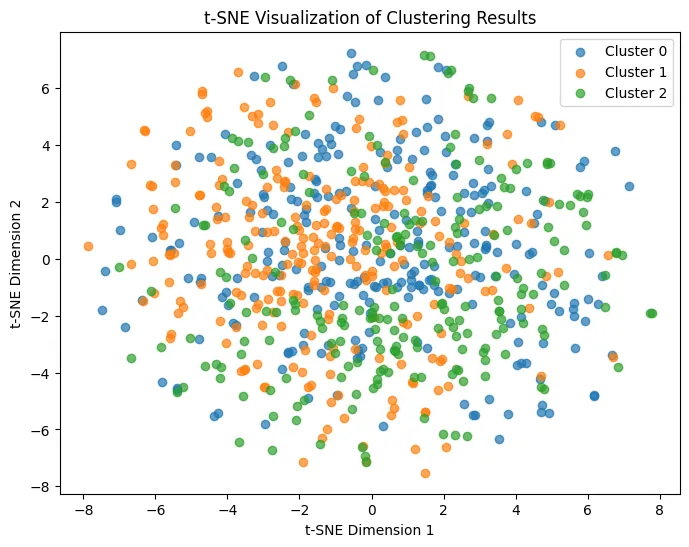
t-SNE를 이용해서 각 클러스터링에 속하는 사람들을 2차원 공간상에 시각화 할 수 있다.
클러스터 별 장르/ 영화 구성 확인
Cluster 0 Top Genres: Drama, Comedy, Action
Movies:
Drama: Contact (1997), Fargo (1996), Chasing Amy (1997)
Comedy: Liar Liar (1997), Toy Story (1995), Back to the Future (1985)
Action: Star Wars (1977), Return of the Jedi (1983), Air Force One (1997)

Cluster 1 Top Genres: Drama, Comedy, Action
Movies:
Drama: Fargo (1996), English Patient, The (1996), Contact (1997)
Comedy: Toy Story (1995), Liar Liar (1997), Back to the Future (1985)
Action: Star Wars (1977), Return of the Jedi (1983), Godfather, The (1972)

Cluster 2 Top Genres: Drama, Comedy, Action
Movies:
Drama: Contact (1997), English Patient, The (1996), Fargo (1996)
Comedy: Liar Liar (1997), Toy Story (1995), Willy Wonka and the Chocolate Factory (1971)
Action: Star Wars (1977), Return of the Jedi (1983), Independence Day (ID4) (1996)
각 클러스터별로 top Genre를 나눠서 추출할 수 있다.
클러스터 별 유저 정보 확인
Cluster 0 Top Occupations:
student: 22.18%
other: 12.41%
administrator: 8.65%
educator: 8.65%
engineer: 7.14%

Cluster 1 Top Occupations:
student: 16.15%
other: 11.54%
educator: 11.54%
engineer: 8.46%
administrator: 8.08%

Cluster 2 Top Occupations:
student: 21.49%
other: 10.96%
programmer: 9.21%
educator: 8.77%
administrator: 8.77%
클러스터링 된 사용자 그룹 내에서 클러스터가 어떤 직업으로 이루어져 있는지를 확인해 볼 수 있다.
Continue exploring
더 읽어보기
CTR을 예측할 수 있을리가 없잖아 무리무리!(무리가아니었다!?): nemotron persona
어떤 광고 배너가 잘될지는 결국 집행 비용을 써봐야 알 수 있었다. 배너를 많이 만들 수 있어도, 그중 무엇을 내보낼지 고르는 데는 여전히 돈이 들었다. 집행 전에 후보를 걸러낼 수 있을지 확인하려고 NVIDIA Nemotron Persona-Korea 데이터셋으...
카피 A/B 테스트와 밈으로 광고 성과를 끌어올리기
광고 배너를 자동으로 만들 수 있게 된 뒤에는 어떤 카피를 얹을지가 다음 과제였다. 성과가 높은 카피, 재밌는 카피에는 정해진 Ground Truth가 없었다. 여러 톤앤매너와 밈 RAG로 후보를 만들고 실제 광고 성과를 비교했다.
성과가 난 광고에서 다음 스토리를 찾는 위닝앵글 검색
초기 AX 제작은 좋아요 랭킹 순으로 스토리를 넓게 탐색하는 방식이었다. 이후에는 이미 성과가 난 광고에서 다음 후보를 찾는 경로를 만들었다. 다른 팀원이 만든 에이전트의 광고 성과 분석과 인사이트를 받아, 비슷한 소구점이나 이미지를 가진 새로운 스토리를 발굴하는...